Category: Middle Eastern Conflicts

  • US-Yemen

    Manually added context [December 8th]:

    The current UAE–US–Saudi operation in Yemen may stem from coordination following Donald Trump’s meeting with Crown Prince Mohammed bin Salman in mid‑November 2025.

    It is very likely that U.S. forces conducted the late November and early December 2025 drone strikes in Yemen that killed senior Al‑Qaeda in the Arabian Peninsula leaders.

    Since the April 2022 truce, Saudi Arabia and the UAE-backed Southern Transitional Council (STC) have largely avoided airstrikes in Yemen, while the U.S. has conducted counterterrorism operations against Houthis and AQAP members.
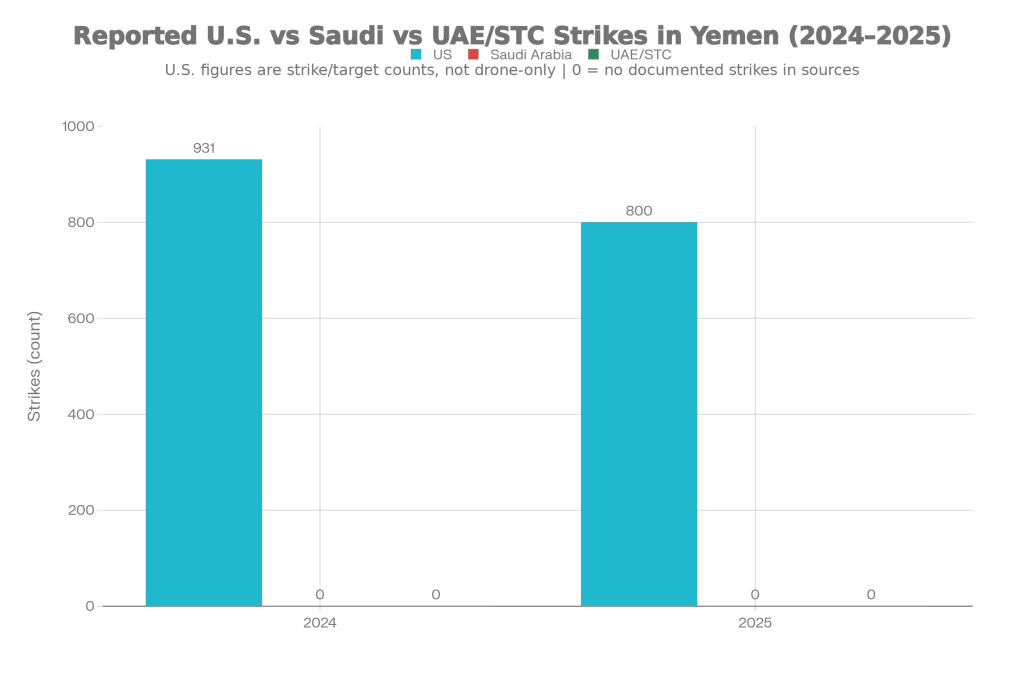
    Update [December 9th]:

    The two main high-value targets (HVT) of the US airstrike were AQAP senior figures:

    Abu Ubaydah al-Hadrami – sharia official

    Anis al-Hasali – counterintelligence and security commander

    Update [December 10th]:

    The current source list covers most primary Yemen-conflict stakeholders, and several cited outlets operate in tightly state-managed media environments aligned with Saudi Arabia, the UAE, Bahrain, and Egypt.

    In that context, these governments have limited incentive to inaccurately shift responsibility to Washington for strikes they did not authorize, as doing so would risk diplomatic friction with a key security partner and complicate their own regional messaging.

    The absence of declassified U.S. reporting is not unexpected. President Donald Trump’s 2025 counterterrorism posture has been operationally assertive, and his first administration also reduced certain civilian-casualty transparency requirements in 2019, arguing the reporting was unnecessary.

    It is also notable that this would not be the first reported U.S.-linked removal of AQAP figures in late 2025. In November, local reporting alleged that a U.S. drone strike killed Abu Muhammad al‑Sanaani in the Al‑Shabwah area. (Later verified by NewAmerica and AcledData)

    What about Al Jazeera? [December 11th]:

    Al Jazeera (Qatar) hasn’t reported yet on this strike or the previous one in November. UAE, Saudi, Bahrain and Egypt have all reported on it.

    As mentioned before, all these countries’ political news are strictly state-narrated. This discrepancy likely stems from the political control of Marib and how each bloc views the dominant faction there: The Islah Party.

    The Marib province is the last major stronghold of the internationally recognized government in the north. However, practically, it is dominated by the Islah Party (the Yemeni branch of the Muslim Brotherhood).

    Qatar generally supports the Muslim Brotherhood and has historically supported Islah as a legitimate political force. However, the UAE, Saudi Arabia, Egypt, and Bahrain view the Muslim Brotherhood as a terrorist organization or a dangerous political threat. The UAE, in particular, is openly hostile to Islah.

    By highlighting that Al-Qaeda operatives are active and being targeted in Marib, they subtly discredit the Islah party’s governance.

    Highlighting Al-Qaeda’s presence there validates the UAE/STC accusation that Islah is tolerant of or infiltrated by extremists. Al Jazeera typically frames Marib as the heroic “last stand” of the legitimate government against the Houthis, not as a terror hub.

  • Gaza Ceasefire Phase 2

    Israel and Hamas are approaching “Ceasefire Phase 2” with more forward motion than at any point since the phased truce began, but the hardest political decisions—Israeli withdrawal terms, Gaza governance, and Hamas’s weapons—are still unresolved.

    Still, multiple mediators are signaling that a Phase 2 agreement is expected before the end of 2025 because the monitoring architecture is taking shape, the main external brokers are aligned, and leaders on all sides are trying to lock in guarantees before the calendar—and domestic politics—shifts again.


    What is Phase 2

    Phase 2 talks are widely framed as the stage meant to negotiate an end to the war, including the return of remaining living hostages and the withdrawal of Israeli troops from Gaza.

    Phase 2’s outline includes further Israeli withdrawal, creation of a transitional authority in Gaza, deployment of a multinational security force, Hamas disarmament, and the start of reconstruction.


    The Current Progress

    Israeli Prime Minister Benjamin Netanyahu has publicly said he expects the ceasefire to move into the second phase “very shortly,” while describing it as “more difficult” than Phase 1.

    Qatar’s prime minister has also said mediators “led by the U.S.” are working to “force the way forward” into Phase 2, while warning that what exists now is closer to a pause than a completed ceasefire without full withdrawal and restored normal movement.


    Expected Agreement

    A crucial shift is that mediators are increasingly framing the 2025 goal as reaching a political and legal agreement on Phase 2, while acknowledging that full compliance and monitoring will roll out more slowly.

    This approach mirrors other complex peace processes, where the peace accord is signed under time pressure, and only later do the parties fully meet conditions such as disarmament or territorial withdrawal.

    Donald Trump’s White House has injected an additional time-bound incentive by tying U.S. political capital and security guarantees to reaching a second-phase accord this year.

    Reports describe Trump making personal commitments to both Israel and Arab partners that Washington will not allow either side to simply walk away from the deal once signed, a message designed to reassure negotiators that whatever is agreed in 2025 will not evaporate with the next crisis.

    Netanyahu’s planned meeting with Trump in December is framed explicitly around closing the gap to a Phase 2 deal, and both sides have an interest in announcing at least a signed framework or “understanding” before year’s end.

    For Trump, delivering a formal agreement—even if enforcement remains contested—is a headline diplomatic achievement; for Netanyahu, it diffuses international pressure and reframes the conflict as being on a managed diplomatic track.


  • Israel-Gaza

    The current state of Polymarket’s “Israel strikes on Gaza” market is outright terrible.

    Multiple airstrikes reported by several credible sources have been rejected and resolved as “No.” As a result, I will discontinue this probability tracker..

    At this stage, it’s a gambling game dependant on explicit confirmation by the IDF or Reuters, rather than on a broader assessment of credible reporting.

  • Israel-Lebanon

    Israel Airstrike on Lebanon Today? – Dec 8 2025

    12/12
    100% probability

    Sources (≥45 Global SM Score)

    Source Probability Added
    Multiple reports and IDF confirmation of Airstrikes. +12